A lot of performance conversations in Nova Scotia these days circle back to one question: how do you get big turbo power without the wait? SRT, the performance division behind Dodge’s fastest machines, just showed one possible answer, and it starts with electricity instead of exhaust.
What SRT’s eBoost Air Concept Actually Is
eBoost Air is a powertrain concept from Stellantis’ SRT performance division, not a production model or a trim you can order. It’s a proof-of-concept, built to demonstrate a way to solve one specific problem: turbo lag in large turbochargers.
Big turbos make big power, but they need strong exhaust flow to spool up, and that flow only shows up at higher engine speeds. At lower rpm, the wait for boost is the tradeoff performance drivers have lived with for decades.
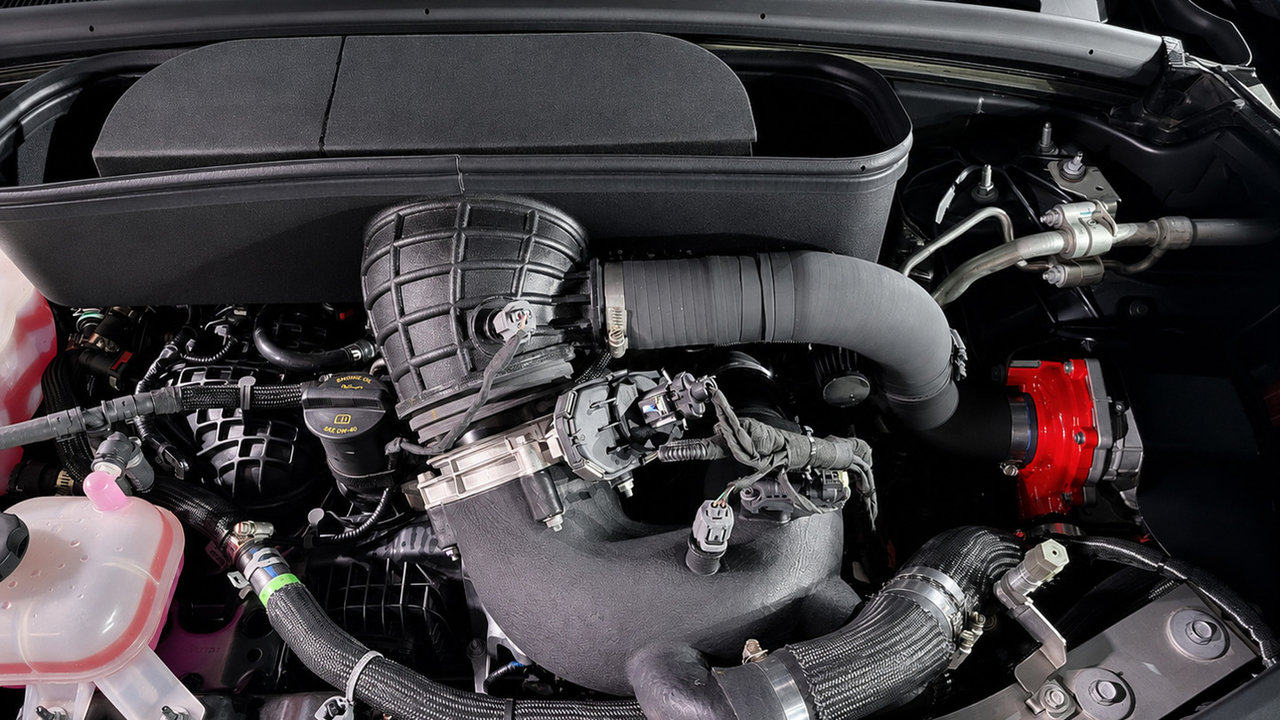
SRT demonstrated eBoost Air on a prototype 3.0-litre twin-turbo Hurricane inline-six, the same engine family already powering Dodge’s SIXPACK-equipped Charger lineup. This is a technology preview, proving the concept works, not an announcement of a new model or engine lineup.
How the Electric Pre-Spool System Works
Standard turbo systems rely on exhaust energy alone. Exhaust gas spins the turbine, the turbine forces more air into the engine, and the engine makes more power. It’s efficient, since it captures energy that would otherwise go to waste, but it only works once there’s enough exhaust pressure to do the job.
eBoost Air adds an electrically driven e-compressor upstream of the turbochargers. When a driver asks for immediate torque and the turbos haven’t reached operating speed yet, an electronically controlled bypass system routes airflow through the e-compressor instead. That compressor spins up fast, building boost pressure before exhaust energy is available to do it the traditional way.
As engine speed climbs and exhaust flow becomes strong enough to spool the turbos on its own, the system hands off. Airflow returns to the normal induction path and the exhaust-driven turbos take over, sustaining boost the way they always have.
|
Stage |
What’s Doing the Work |
|
Off idle / low rpm |
Electric e-compressor pre-spools the turbos |
|
Transition |
Electronically controlled bypass manages the handoff |
|
Higher rpm |
Exhaust-driven turbochargers sustain boost |
Why This Matters for Real Driving

The practical upside is stronger throttle response right off idle, without the pause that traditionally comes before a large turbo wakes up. SRT describes the result as a broader, more linear power band across the rev range, closer to the instant feel enthusiasts associate with a supercharged V8 than a conventional turbo setup.
That matters because traditional turbo systems have always asked drivers to trade something for power. Bigger turbos meant more lag. eBoost Air is framed as a way to keep the efficiency of exhaust-driven boost while cutting the wait most drivers associate with big turbocharged engines.
According to SRT operations lead Tom Sacoman, electromechanically pre-spooling the turbochargers before exhaust energy is available meaningfully improves boost response and drivability. That’s the difference between an engine that feels alert the moment you touch the throttle and one that needs a beat to catch up.
Who This Kind Of Technology Signals Value For
The clearest audience here is anyone who already cross-shops high-output turbocharged inline-six performance, the kind of driver who wants big numbers without living with the lag that big numbers usually demand. A prototype built around the Hurricane inline-six, the engine already doing work in Dodge’s Charger SIXPACK models, suggests SRT is thinking about how to sharpen an engine family Canadian Dodge buyers already know.
It also matters to anyone curious about where SRT is spending its engineering time. SRT’s stated mission is to move fast on performance technology across Dodge, Jeep, and Ram, using SRT as an incubator that takes ideas from paper to prototype in weeks rather than years. eBoost Air is proof that mission is active, not just a slogan.
This is not a purchase decision. There’s no trim lineup, no pricing, and no confirmed path to production tied to this announcement. It’s a look at the kind of engineering problem SRT is choosing to solve next.
Keeping An Eye On What Comes Next From Dodge and SRT
eBoost Air shows how SRT is approaching one of turbocharging’s oldest tradeoffs, using electric pre-spooling to close the gap between idle and full boost on a Hurricane inline-six prototype. It’s a technology story right now, built on a proof-of-concept engine rather than a showroom vehicle.
Visit Blaikies Dodge Chrysler Limited in Truro to talk through the Hurricane-powered Dodge models already on the road today, and ask our team what SRT’s latest performance thinking could mean down the line.